
While in class we mainly focused on analyzing
the various Disney films, another pillar of Disney are their theme parks. As
visitors, we can only see the final polished product, with little knowledge
about how an attraction was created. Located adjacent to the famous Disneyland
is Disney’s California Adventure. Built in 2001, critics bashed Disney for
cutting corners and building the park on the cheap. More recently, however,
Disney started to renovate certain parts of the new park in order to bring them
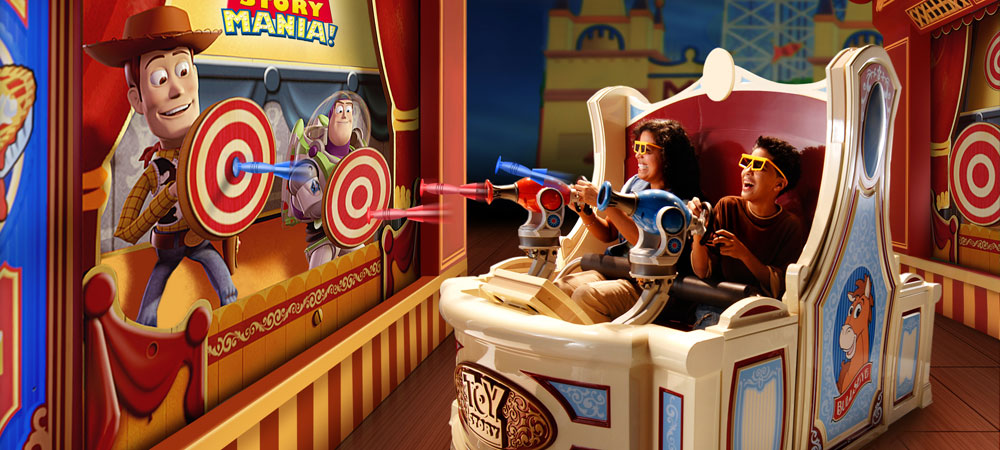
in line with their lofty standards. One of these new attractions is called Toy
Story Mania, where visitors can play virtual-reality versions of classic
carnival games.
Disney began working on the new ride in the summer
of 2005 when they sent a team of creative developers to the Los Angeles County
Fair with the goal of researching how carnival games work. They came up with
the idea to juxtapose the old-fashioned carnival games with new high-tech video
game elements. The developers believed that Toy
Story and Toy Story 2 would
provide a good theme for this idea, but needed to better understand how the
traditional carnival games worked before they could convert them to compelling
virtual-reality versions. A couple developers conceived the premise that the
attraction would run on: the classic toys in the movies staged a carnival under
Andy’s bed while he was eating dinner. With the solid sense of the theme and
the components that they wanted to include, the development team pitched the
idea to Robert Iger, the head of Disney.
Iger was interested yet hesitant, so the plans moved on to the next step: building an elaborate model. Paying close attention to scale and sight lines, engineers build intricate models on large tables equipped with wheels. In what seems like Disneyphile’s dream come true, the company keeps entire room-sized models of entire parks so that engineers can wheel the models into place to see how it would look. While some designers continued to work on tweaking the various elements, others moved onto creating the blueprints for the computer program that would run along with ride. Since it is much cheaper to address issues before construction, developers carefully examined the simulations to make sure there were no issues.
Disney also began to test rudimentary versions
of the ride with 400 people of varying ages and backgrounds. Obviously confined
by stringent nondisclosure agreements, these subjects played basic versions of
the games while Disney worker’s studied their reactions. They learned that
attendees wanted to be able to compare their scores, and that certain controls
were hard to reach for smaller riders (which is obviously makes up a large part
of their customer base.) Disney also decided to increase the visual payoffs of
completing various acts (like a gust of wind when you pop a virtual balloon),
and wanted to make the last carnival game that riders play would be the easiest
so that they would leave feeling like winners.

One of the more creepy additions was that of an
animatronic Mr. Potato Head that would keep visitors entertained as they wait
in line. Armed with a budget of $1 million, Disney went all out in creating an
advanced figure. Developers were able to make him sing, dance, and appear to
hold conversations with visitors. They brought in Don Rickles (the voice of Mr.
Potato Head in the movies) to record various words and songs. There is a hidden
ride operator, who uses hidden cameras and a computer to scan the crowd in
order to see what pre-recorded phrases apply the appearances and actions of
those standing in front of it.
Roughly
three years and $80 million later, and Disney hopes to have created a new type
of iconic ride, adapted to the new demands of today’s visitors. When I visited
the theme park a couple years ago, I distinctly remember enjoying the Toy Story
Mania ride (which I can only say about a handful of rides in the whole park.) While
it was one of my favorite attractions then, I believe that I will appreciate it
even more next time I go after taking a behind-the-scenes look at how it was
created. While we cannot expect to learn the inside scoop of how each ride was
created, especially considering the veiled nature of Disney, this knowledge
certainly augments one’s appreciation for the ride after seeing all the effort
that goes into the development.
http://www.nytimes.com/2008/02/10/business/media/10ride.html?pagewanted=all&_r=0
http://c500228.r28.cf2.rackcdn.com/toy-story-mania/branding_TS%20Mania%20keyart.jpg
http://dedicatedtodlp.com/wp-content/uploads/2012/04/toy-story-mania.jpghttp://c500228.r28.cf2.rackcdn.com/toy-story-mania/branding_TS%20Mania%20keyart.jpg
http://www.studioscentral.com/sites/default/files/imagecache/attraction_gallery_large/toy_story_mania_potato_head.jpg

No comments:
Post a Comment