Monday, December 2, 2013

Toy Story Mania: Disney's Revamped Attraction in Disney Land


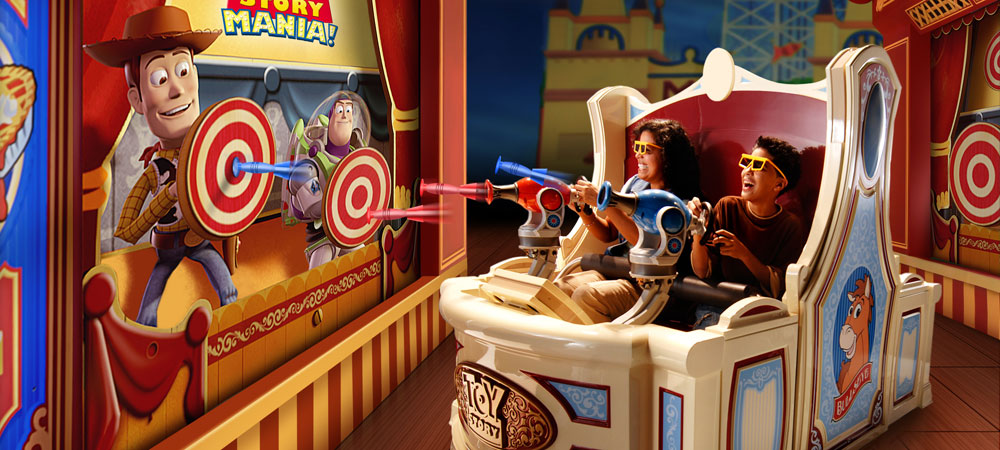
While in class we mainly focused on analyzing the various Disney films, another pillar of Disney are their theme parks. As visitors, we can only see the final polished product, with little knowledge about how an attraction was created. Located adjacent to the famous Disneyland is Disney’s California Adventure. Built in 2001, critics bashed Disney for cutting corners and building the park on the cheap. More recently, however, Disney started to renovate certain parts of the new park in order to bring them in line with their lofty standards. One of these new attractions is called Toy Story Mania, where visitors can play virtual-reality versions of classic carnival games.
Disney began working on the new ride in the summer of 2005 when they sent a team of creative developers to the Los Angeles County Fair with the goal of researching how carnival games work. They came up with the idea to juxtapose the old-fashioned carnival games with new high-tech video game elements. The developers believed that Toy Story and Toy Story 2 would provide a good theme for this idea, but needed to better understand how the traditional carnival games worked before they could convert them to compelling virtual-reality versions. A couple developers conceived the premise that the attraction would run on: the classic toys in the movies staged a carnival under Andy’s bed while he was eating dinner. With the solid sense of the theme and the components that they wanted to include, the development team pitched the idea to Robert Iger, the head of Disney.


Iger was interested yet hesitant, so the plans moved on to the next step: building an elaborate model. Paying close attention to scale and sight lines, engineers build intricate models on large tables equipped with wheels. In what seems like Disneyphile’s dream come true, the company keeps entire room-sized models of entire parks so that engineers can wheel the models into place to see how it would look. While some designers continued to work on tweaking the various elements, others moved onto creating the blueprints for the computer program that would run along with ride. Since it is much cheaper to address issues before construction, developers carefully examined the simulations to make sure there were no issues.
Disney also began to test rudimentary versions of the ride with 400 people of varying ages and backgrounds. Obviously confined by stringent nondisclosure agreements, these subjects played basic versions of the games while Disney worker’s studied their reactions. They learned that attendees wanted to be able to compare their scores, and that certain controls were hard to reach for smaller riders (which is obviously makes up a large part of their customer base.) Disney also decided to increase the visual payoffs of completing various acts (like a gust of wind when you pop a virtual balloon), and wanted to make the last carnival game that riders play would be the easiest so that they would leave feeling like winners.


One of the more creepy additions was that of an animatronic Mr. Potato Head that would keep visitors entertained as they wait in line. Armed with a budget of $1 million, Disney went all out in creating an advanced figure. Developers were able to make him sing, dance, and appear to hold conversations with visitors. They brought in Don Rickles (the voice of Mr. Potato Head in the movies) to record various words and songs. There is a hidden ride operator, who uses hidden cameras and a computer to scan the crowd in order to see what pre-recorded phrases apply the appearances and actions of those standing in front of it.  
            Roughly three years and $80 million later, and Disney hopes to have created a new type of iconic ride, adapted to the new demands of today’s visitors. When I visited the theme park a couple years ago, I distinctly remember enjoying the Toy Story Mania ride (which I can only say about a handful of rides in the whole park.) While it was one of my favorite attractions then, I believe that I will appreciate it even more next time I go after taking a behind-the-scenes look at how it was created. While we cannot expect to learn the inside scoop of how each ride was created, especially considering the veiled nature of Disney, this knowledge certainly augments one’s appreciation for the ride after seeing all the effort that goes into the development.

http://www.nytimes.com/2008/02/10/business/media/10ride.html?pagewanted=all&_r=0
http://c500228.r28.cf2.rackcdn.com/toy-story-mania/branding_TS%20Mania%20keyart.jpg
http://dedicatedtodlp.com/wp-content/uploads/2012/04/toy-story-mania.jpg
http://www.studioscentral.com/sites/default/files/imagecache/attraction_gallery_large/toy_story_mania_potato_head.jpg

Wednesday, November 27, 2013

Flynn Rider: Observations of Disney Movies


I saw this image searching around the internet, and it made me think about all the movies we watched in class. He might have a point since it's somewhat strange how the characters in the films randomly breakout singing.

http://www.dumpaday.com/wp-content/uploads/2013/01/a-funny-disney-characters.jpg

Tuesday, November 19, 2013

The Role of Marketing in Princess and the Frog


In the article "The Strange Case of The Princess and the Frog: Passing and the Elision of Race," Ajay Gehlawat looks at Tianna's racial identity and the film's portrayal of her race. Specifically, Gehlawat mentions a possible motive for Disney's choices in their rendering of Tianna: money. This motivation for financial gains definitely seems to make sense given its context. As a business, Disney definitely should be concerned with enhancing their bottom line by producing films that audiences want to see. As Gehlawat notes, it appears that Disney attempts to broaden its audience base by appealing to people of different races with characters of various races. In other words, Disney tried to increase its viewership by adding characters of different races so that more people could relate to them. Gehlawat argues that Tianna's race is completely ignored, so much that she is shown as a princess (of sorts) who just happens to also be black. While some may think that this completely negates Disney's progress by showing a black princess for the first time, I feel that it shows how Disney has evolved with the times and now promote an updated mentality. They make a leap forward by having a princess who is black in the sense that they no longer view it as much of a taboo subject anymore. Since people have become more open-minded and less racist over time, Disney was able to have their protagonist be a character of color. While in the past it is possible that some people would have boycotted the film due to this, Disney's decision reflects how they think that the public can now embrace a black princess. For this reason, even though Disney largely ignores the issues of race in the film, their decision to make such a movie in the first place reflects how they believe people have an updated mindset of acceptance. 

"The Strange Case of The Princess and the Frog: Passing and the Elision of Race" by Ajay Gehlawat
http://www.goggleboxed.com/wp-content/uploads/2012/12/The-Princess-and-the-Frog-UK-Poster.jpeg

Thursday, November 14, 2013

Messages in Pixar Films


Here is a link to an article talking about the messages shown in 12 Pixar movies. I can't remember watching all of them (and didn't think much about the messages in the movies that I did watch), so I found it interesting to see the main ideas that Pixar focus on in their films. 

http://www.deseretnews.com/article/705375854/12-Pixar-movies-12-messages-for-families.html?pg=all

http://collider.com/wp-content/uploads/pixar-logo.jpg

Sunday, November 10, 2013

Disney's Decisions: Princess and the Frog versus Hunchback of Notre Dame

The depiction of race and disability in The Princess and the Frog and The Hunchback of Notre Dame, respectively, remains among the largest critiques of those who watch these films. However, Disney’s sensitivity with regard to these two issues vastly varies between the two films. In the essay “Blackness, Bayous and Gumbo: Encoding and Decoding Race in a Colorblind World,” Sarah Turner mentions how Disney consulted with the NAACP and Oprah (an interesting choice as well) to examine their portrayal of race. On the other hand, in “'You’re a Surprise from Every Angle’: Disability, Identity, and Otherness in The Hunchback of Notre Dame,” Martin Norden explains how Disney declined to consult with anyone regarding their portrayal of disability in The Hunchback of Notre Dame. Both of the authors highlight this fact, which leads one to further consider the implications of this decision. Since we do not know Disney’s true motives, I will have some fun and speculate about a few options that seem more likely.
One theory is that Disney learned that they had to be more sensitive to their portrayal of “other.” After receiving a considerable amount of backlash for their portrayal of disability in The Hunchback of Notre Dame, its possible that Disney realized that they had to take more consideration in the varied demographics of their viewers. Even though it does not change how they depict disability in The Hunchback of Notre Dame, it does show how Disney learned from their mistakes to grow as a company. This reasoning would mean that Disney does not necessarily value the issue of race more than disability, but that they simply learned from their previous mistakes (and could have happened in reverse if the order of their releases had switched.)
A more pessimistic proposition for Disney’s decision is that they did not consider disability to be a major concern, and therefore ignored the issue altogether. Critics would say that by only consulting outsiders about the representation of African-Americans, and refusing to do so in their depiction of disability, Disney completely ignores the opinions of the millions of disabled viewers and how they would perceive it. This critique would focus on how Disney is sensitive to issues regarding race, while insensitive to concerns over disability.
A third more naïve option is that Disney did not realize that some people would be discouraged by their portrayal of the disabled. This suggestion would align more with Disney’s public statements regarding the issue, as they state that it is merely for entertainment, or that they stand behind their representation as a positive model. While this certainly takes the blame away from Disney, it seems unlikely that a massive corporation like Disney would be totally oblivious to the messages they portray in their movies. For this reason, I believe that this is not likely to be the case, although I mention this since it would likely be the standard Disney explanation.

Ultimately, we will likely never know the true reasons behind Disney’s judgment. The potential reasons above delineate a spectrum of reasons for Disney’s decision, ranging from realistic to pessimistic to naïve. We are left to decide for ourselves why we think Disney made the choices that they did. And considering the nature of the issue, it’s likely that we will never know the actual motivation. However, in the absence of factual evidence, we are only left to speculate and try to decipher the tealeaves that the company provides us.

"Blackness, Bayous and Gumbo: Encoding and Decoding Race in a Colorblind World” by Sarah Turner 
“'You’re a Surprise from Every Angle’: Disability, Identity, and Otherness in The Hunchback of Notre Dame” by Martin Norden
http://www.theguardian.com/film/filmblog/2010/feb/01/pixar-walt-disney-company

Saturday, November 2, 2013

Golden Oak: Disney's Upscale Gated Community


Aerial view of Golden Oak housing community. Still not positive if this is a real satellite image or a realistic rendering.

For those who are massive Disney fanatics (and have millions of dollars), the gated community called Golden Oak is the ideal place to live. Situated at the Lake Buena Vista site in Orlando, Florida, the gated community is the only place in the world where you can own a home within the boundaries of Disney properties. While the price of owning a home in Golden Oak is quite high, the many amenities outweigh the costs for some wealthy Disney aficionados. 

Disney, which previously had not developed the land, wanted to create a community for people who frequently visited the theme park. Located just four miles from Disney world, some houses are even able to see the fireworks from the Cinderella Castle. The idea for this high-end community arose in 2007, but the financial downturn sidelined these plans for a few years. The first homes were sold nearly three years ago, and so far 100 have been sold. Capable of holding up to 450 houses, Golden Oak sits on approximately 980 acres. Given its close proximity to the Disney World Resort, homeowners are able to take advantage of many perks.

The benefits of living in Golden Oak are primarily due to its location near the Disney World Resort. First of all, all the residents receive park passes, as well as extended hours to visit attractions like the Magic Kingdom and Epcot. To help them get from their homes to the parks (and avoid the hassle of parking and other traffic), residents receive door-to-park transportation. There is a 17,000-square-foot clubhouse that comes complete with a concierge staff. Overall, the two main benefits are the optimal location along with the outstanding amenities.

A typical home in Golden Oak. Certainly not the worst place to live.
The houses themselves are very luxurious, with the cost of ownership starting at $1.7 million (and some have sold for over $7 million.) The styles of the homes range from Tuscan to Mediterranean, and many have large open areas conducive to hosting one's family. The selection process for builders is very stringent. There are only seven builders who have been allowed to construct homes in Golden Oak. Contractors and residents face strict restrictions on everything from landscaping to design. All of this attention to detail comes at a high cost, but may be worth it to the most diehard Disney fans.  

One of the more peculiar aspects of the homes is the option to add hidden Mickey ears that are built into the rooms. These "hidden Mickeys" can be found anywhere from the tile work to stair railings. In one of the showcase homes completed this year, the builder estimated that he had hid 75 Mickey ears. Since some of them are difficult to find, the new homeowner will receive a map of all of the locations that they are located within the home. While this all many seem like a frivolous addition, the homeowners enjoy the game of trying to find all of them. 

The Golden Oak gated community certainly is not for everybody. The connection to Disney is undoubtably one of the main draws. But for most even the enthusiastic Disney fans, the high price tag of buying a home prevents them from doing so. However, for those who love visiting Disney World and have millions of dollars lying around, this seems like the perfect place to live. 


Bonus: Do a google image search for "Golden Oak Disney" to see some more pictures of the homes. Luxurious would be one way to describe them. 

Wotapka, Dawn. "Is There a Mouse in the House?" The Wall Street Journal. N.p., 31 Oct. 2013. Web.
http://online.wsj.com/news/articles/SB10001424052702304799404579156041555394268

Tuesday, October 29, 2013

New Gender Roles in Pixar films


In their essay "Post-Princess Models of Gender: The New Man in Disney/Pixar," Ken Gillam and Shannon Wooden propose a new model for male characters in Pixar's animated films. Specifically, they examined the portrayal of the male protagonists in Cars, Toy Story, and The Incredibles. Collectively, Gillam and Wooden note how Pixar promotes a new model of masculinity, and how each of the main male characters follow the same pattern in their character development. While the article makes some provocative connections, I think an interesting idea worthy of further examination is Gillam and Wooden's decision to write about the portrayal of males. In this course, we read a lot of essays about how Disney depicts women. This definitely was appropriate, especially considering how many of the princesses in the films were characterized. However, I found this essay compelling because it discussed a different perspective from many of the other articles we read. Since Disney markets their films to appeal to a wide range of people, it makes sense to look at how male characters are portrayed (in addition to female characters.) Much like how Disney has historically shown physically disproportionate females, they also have often presented males in unrealistic ways, with masculine traits such as physical strength way over-emphasized. With this in mind, I found Gillam and Wooden's essay stimulating as we got to evaluate Disney's message and its effect from a different perspective. 

"Post-Princess Models of Gender: The New Man in Disney/Pixar" by Ken Gillam and Shannon Wooden
http://www.chroniclesofmania.com/wp-content/uploads/2013/08/Lightning-McQueen-disney-pixar-cars-772510_1700_1100.jpg

Friday, October 25, 2013

Distinction between Wealth and Power in Aladdin


In Erin Addison's essay, "Saving Other Women from Other Men: Disney's Aladdin," she notes an interesting distinction between wealth and power. While these two objects are often viewed almost synonymously, I found it  thought-provoking to look at how they are portrayed very differently in Aladdin. In the movie, we see how Aladdin's goal to obtain wealth is viewed as a positive. On the other hand, the audience can see how Jafar's desire to gain power is seen negatively. Disney's decision to depict these often interchangeable terms in very different lights is intriguing. Perhaps since Disney is based in America, the center of capitalism, Disney wants to show the ambition for wealth to be a positive thing. Conversely, they may want to illustrate how the craving for power is a negative thing in order to warn us about the dangers of power-hungry individuals. Regardless of their motives, I found it compelling to examine the connotations Disney associated with wealth and power.

"Saving Other Women from Other Men: Disney's Aladdin" by Erin Addison
http://images2.fanpop.com/images/photos/5700000/Aladdin-Wallpaper-aladdin-5776538-1024-768.jpg

Saturday, October 19, 2013

Top Comments on Youtube videos about Disney

Here is an article that lists some of popular comments that watchers have left in the comments of some Disney videos. I believe we talked about #14 in class, as the commenter asks why the dwarfs leave the key to the vault right outside the door, and some of the others relate to movies that we have watched in class. Overall, this article caught my attention as many of the comments note some interesting (and funny) observations.

http://www.buzzfeed.com/jessicamisener/the-16-funniest-youtube-comments-on-disney-movie-clips

Thursday, October 10, 2013

Sunday, September 29, 2013

Walitarianism and the Characterization of Walt Disney


In the article "The Wonderful World of the Depression: Disney, Despotism, and the 1930's. Or, Why Disney Scares Us," Kevin Shortsleeve comes off as a writer desperate in his explanations about how Walt Disney was an anti-Semitic, egotistical dictator, and utopian-society designer. While Shortsleeve may certainly have some valid criticism of Walt Disney as a person, his many logical leaps and poorly-supported ideas greatly detract from his overall argument. In particular, I found a few examples where I had some strong reservations.
One instance where I thought Shortsleeve stretched the truth was when he claimed that Disney essentially took all of the credit for the work (and ignored all of his animators.) However, when you look at the screenshot above (taken from the video in my earlier blog post about the animation process,) Walt Disney does not come off as a person who is taking sole responsibility for the work. While he doesn't name each animator individually, he seems to genuinely appreciate and acknowledge the effort of others as they helped produce the film.
Another example where I questioned the validity of Shortsleeve's evidence was his anecdote about certain Disney employees receiving double the compensation for moving barriers faster than others. While this event certainly could have transpired, it mirrors his argument too perfectly, so much so that it appears fabricated. Not only does it appear to be made-up, but it also doesn't provide evidence that two people did the same job and received different compensation. Instead of considering that the supervisor might have set up a competition with the rules delineated ahead of time, Shortsleeve only takes this (possibly made-up) situation to show how some people earned twice the wage as others.
The last occurrence that made me question Shortsleeve's motives was his comparison between Walt Disney and Hitler. Immediately, I thought it was extremely strange to compare a dictator responsible for the death of millions of people with the founder of a company that produces animated movies aimed at children. While Shortsleeve says that "Of course, Walt Disney was no Hitler" (14), the comparison is offensive in the sense that the two people relate to issues of very different magnitudes.
Overall, I found Shortsleeve's lengthy article detailing the character of Walt Disney to be poorly supported at times, and completely fabricated at others. While at first glance it appears like he makes a lot of valid arguments, his decision to include these details severely detracts from his entire article as he comes off as a biased writer looking to smear the reputation of Walt Disney.

"The Wonderful World of the Depression: Disney, Despotism, and the 1930's. Or, Why Disney Scares Us" by Kevin Shortsleeve

Tuesday, September 24, 2013

Disney's Adaptation of The Little Mermaid


In her article "Disney's Sub/version of Andersen's The Little Mermaid," Roberta Trites argues how Disney's alterations from Hans Christian Anderson's original tale results in a "movie even more sexist than the original story" (145). Trites then goes on to compare the two stories in greater detail. Even if Trites is accurate in saying that Disney's new depiction is more sexist than Anderson's, she must acknowledge that the original story would be totally inappropriate for a children's movie. And given Disney's standing as a business, it makes complete sense that Disney adapted the original work to appeal to their audience. There are many examples of things that Disney had to change in order to make it more child-friendly (not cutting off Ariel's tongue, the feeling of walking on knives, turning into sea-foam.) All of these aspects would certainly cause parents to hesitate to show their children the film. For this reason alone, it is evident why it was in Disney's best interests as a corporation to tailor the story into a more cheery children's version. Moreover, Trites should recognize that Disney's decision to craft an old tale into a feature film is something that they frequently do. Many of Disney's other movies are based on a fairy tale (or other similar work), and they adapt the main concept of the story into a full-fledged animated movie, often with many changes between the original and new interpretation. For these reasons, Trites' argument is somewhat diminished, since it is apparent that Disney's main motive is to profit by producing films that are enjoyable for a broad audience, and often build off of classic written works in order to craft their animated movies. 

http://disneyvault.net/wp-content/uploads/2012/12/The-Little-Mermaid-3D.2.jpeg

Tuesday, September 17, 2013

Looking at the Animation Process


Behind-the-scenes look at Disney animation


After watching Snow White and the Seven Dwarfs and seeing all of the intricate details along with the smooth motion, I was interested in how Disney created animated films. Following a few minutes of googling around the internet, I found this video, which gives behind-the-scene access inside the Disney studios. The video looks at the animation process as a whole, but focuses specifically on the production of Snow White and the Seven Dwarfs since it was Disney's first full-length feature film. 

While I had some idea of how animators sketched out the characters frame by frame, I was blown away by the amount of effort that go into creating an animated film and was unaware of the lengthy process that was required. The process starts with Walt and his directors looking over a story idea. Next, a director finalizes the script and dialogue, and works on synchronizing the musical score with the action of the film. Then the animators begin sketching out the characters in full detail (but no color).The animators re-copy the characters for each frame, with the characters only slightly moving each time. Once they are ready for the test cinema (to test the smoothness of the characters' movements), they take a picture of each individual slide. 

If the animator deems the work satisfactory, it moved on to the directors room where Walt and his staff review the cinema. Once approved, the animation drawings head to the inking department, where hundreds of girls re-trace every line of every animation onto clear sheets. After they are all transcribed, they move onto the color department, where hundreds of girls work to bring the sketches to life with color. In total, Snow White and the Seven Dwarfs uses over 250,000 clear sheets of cellulite, each painted individually. As all the work on the individual frames goes on, artists paint the stage settings where the action takes place. They use water color, and work for months on backgrounds like the interior of the cabin. 

Once the workers finish, all the backgrounds and sheets of cellulite must then be photographed individually. To create the entirety of Snow White and the Seven Dwarfs, over 500,000 photographs were taken, one at a time. Once all the images are put together, sound effects are added. In what looks like a fun experimental lab, employees produce authentic sounds by a variety of methods, including throwing glass panes onto the ground from ladders and knocking over tall stacks of boxes. Finally, a sympathy orchestra records the final score.

 What stood out the most to me about the entire process was the immense amount of time and effort that went into creating an animated movie. Instead of using a video camera to film people acting like people primarily do today, Disney animators had to hand draw every single character, accounting for all the small movements that make the characters in the film move smoothly. The attention to detail, from the very beginning of the process all the way to the finishing touches, is remarkable. Contrary to how films today often contain computer generated graphical and audio elements, nearly every aspect of the original films was done solely individuals. The amount of collaboration between the different steps of the process is commendable, with each successive step paying close attention to detail. Even if you disagree with the messages being portrayed or simply dislike the film, you must recognize and appreciate the immense amount of effort put into its creation.  

Monday, September 9, 2013

Mickey Mouse: Symbol of a Generation


In the essay "The Masks of Mickey Mouse: Symbol of a Generation," Robert Brockway discusses the character of Mickey Mouse and how his popularity came to be. In particular, I found it interesting how Mickey Mouse evolved over the years, starting as more of an immature child before maturing into a more likable character. I never thought about how animators have the ability to change and develop a character as they determine the direction that they want to go. Growing up well after the inception of Mickey Mouse, I was only exposed the mature Mickey Mouse that exists today. Rather than retaining the slapstick identity, Disney decided to introduce a supporting cast that would exhibit these characteristics, while Mickey would become more of a gentleman. In the short film we watched in class, it was clear that Mickey was a very different character than he is today. He acts very child-like, and doesn't appear to be a very admirable role model. However, his development into a gentlemen, as well as the emergence of a diverse supporting cast, appears to have resurrected Mickey and turned him into a lasting character that has remained popular over the last 80 years.

"The Masks of Mickey Mouse: Symbol of a Generation" by Robert Brockway
http://wallgood.com/wp-content/uploads/2013/07/Mickey-Mouse-HD-Wallpapers-13.jpg